Vagabonds

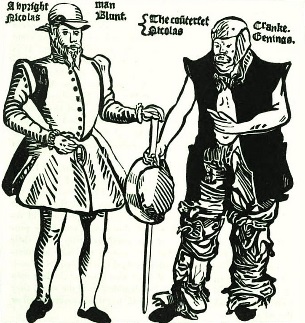
These that do counterfeit the Crank be young knaves and young harlots that deeply dissemble the falling sickness. For the Crank in their language is the “falling evil”. … and never go without a piece of white soap about them, which, if they see cause or present gain, they will privily convey the same into their mouth and so work the same there that they will foam as it were a Boar, and marvelously for a time torment themselves…

A Caveat for Common Cursitors, Vulgarly Called Vagabonds.

Thomas Harman

The sun was going down and it shone red and yellow through the murk like a rotten cracked egg above London. Farmers and drovers were leaving the city, their day’s business done.

He’d been riding a swayback nag for the last two days. Spine like a saw and he hadn’t felt his cock for the last day. He was afraid to look, in case something had been cut off.

Arnold Mulemaker the jeweler lived all the way over on the other side of the city. No way to get there before he closed up for the night. He found that he was again gnawing his lip in frustration and fear. Getting close and it seemed that the closer he got, the slower things moved. He might have shaken that bastard Helmsley in Vlissengen, but there were no guarantees. He had to assume that they were still on his trail. Hell, probably worse than that. They had to know where he was bound, there being so few boltholes open to him now. They were probably already waiting for him in there. So he had that in front of him. He spared a glance over his shoulder to check on what was behind him. Him that called himself Stephen Gardener.

He had to hand it to the little shit, he’d gotten Nick into England, smooth as butter. And now they’d been on the road for three days, heading towards London. Pleasant enough company, always ready with joke or conversation. Stingy with the coin, though, and Nick took him for being completely skint. But with all the jokes and stories, Nick was no closer to knowing who this cove was than when he first woke up and saw him in that room in Vlissengen. One thing he did know for certain. He didn’t trust him. At all. Continue reading “(Broken Instrument) CHAPTER 24: NICK: BACK IN THE SMOKE”
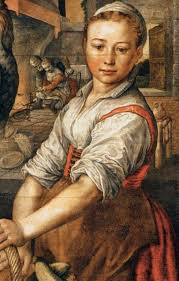
woman01

Despite these obstacles, some women did secure licenses, especially licenses for alehouse-keeping. … Yet the women licensed to keep alehouses in the sixteenth century and later constituted not only a small minority of licensees but also a small minority of a particular sort: they were almost invariably widows.

Ale, Beer, and Brewsters in England

Judith Bennett

The sun was was straight overhead and it shone red and yellow through the murk like a rotten cracked egg above London. Poley was in his element, on the move and surrounded by people, all jostling and talking at the top of their lungs. Ralph walked slightly in front of him, breaking his way through the crowd, giving Poley enough space to speak into Ralph’s ear with a certain degree of privacy.

“Find Ollie the Straight and give him this.” He handed Ralph a folded and sealed piece of paper. “I’ll be at Alewife Harvey’s and it says for him to forward any news he receives to me there with the most pressing urgency. ”

Ralph looked back at Poley and stumbled a bit. “Harvey’s? Why there?” He reached out and took the piece of paper.

“Because she knows me and won’t object to me doing business from her tap room. And she’s smart enough to keep her mouth shut. I can also play her along with hints of her suit making progress at Court.”

Ralph went down Fenchurch, towards the center of the city, and Poley continued towards Kate’s. Now, he barely saw the people around him, his steps taken by instinct, while he spun the jewel of his plan in his mind, carefully inspecting each of its facets.

One of the facets pleased him well. Continue reading “(Broken Instrument) CHAPTER 23: POLEY: OPERATING IN THE SMOKE”

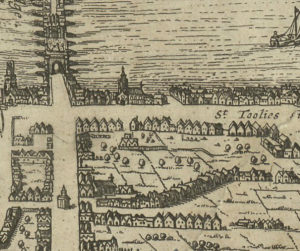
Southwark
Southwark

The South Bank has always been associated with entertainment and pleasure … The prostitutes of the Bankside, practicing their trade within the “Liberty” of the Bishop of Winchester, were known as “Winchester geese”… The area also acquired a reputation for dubious taverns and doubtful pleasure gardens.

London: The Biography

Peter Ackroyd

Even though the sun was only a hands breadth above the horizon, it already shone red and yellow through the murk like a rotten cracked egg above London. Helmsley and Jean had been rowed ashore, through the forest of ships in the London Pool, just after dawn and now they were finally finished with the Customs House. De Langhe’s papers had passed inspection without the slightest twitch of an official eyebrow.

Helmsley had even been congratulated on his service in the Protestant armies of Bohemia, an honor he had made all dissemblance to accept with thankfulness and humility. He passed on invented tales of Catholic perfidy averted by only the most stalwart application of Protestant might and the grace of God. In truth, the encounter did him good. It made clearer in his mind who he was supposed to be, a hard-fighting Protestant soldier, a killer of Catholics and proud of it. Outwardly, he was returned after a long absence and happy to be home. Inwardly, he seethed. Continue reading “(Broken Instrument) CHAPTER 22: HELMSLEY: THE SMOKE OF THE RANKEST HERETICS”

vlissingen01

In 1585, the ports again linked England and the Netherlands by becoming, as so-called cautionary towns, the security guaranteeing the Treaty of Nonsuch, a political and military alliance between England and the United Provinces. In return for English troops and money, the Dutch surrendered Flushing and Brill (Vlissingen and Brielle) to English control as a gesture of good faith.

Historical Dictionary of the Elizabethan World

They arrived in Vlissingen that afternoon on a small ship flying the flag of Holland, one of the United Provinces. The ship carrying Helmsley and Jean was loaded with timber to sell in the port. Its cargo was part of a stockpile used by agents of Hugh Owen to provide cover for their exit from Spanish Flanders. The papers that the captain carried proved that the ship and its cargo and its passengers all hailed from Emden, carrying a load of Baltic timber.

The trip, short as it was, had been a nightmare. Driven by the urgent need to catch that fat bastard Nick, Helmsley had forced the captain to lift anchor the moment he had received the finished papers from de Langhe. Unfortunately, that storm that he had observed massing in the west had been a very slow moving one. The rain lashed them with cold flails and only by laboriously tacking back and forth down the Scheldt had they managed to defeat the strong wind blowing from the west. One small blessing was that the storm had driven all the blockading ships into shelter, so they made their way into the North Sea unimpeded. The storm had finally blown past during the morning and now the midday sun was only intermittently obscured by fast-moving fluffy clouds. The wind blew the sea into whitecaps. Continue reading “(Broken Instrument) CHAPTER 21: HELMSLEY: EARLIER THAT AFTERNOON”


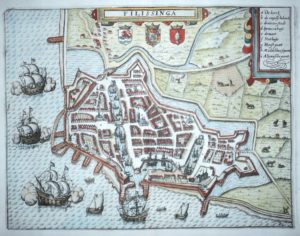
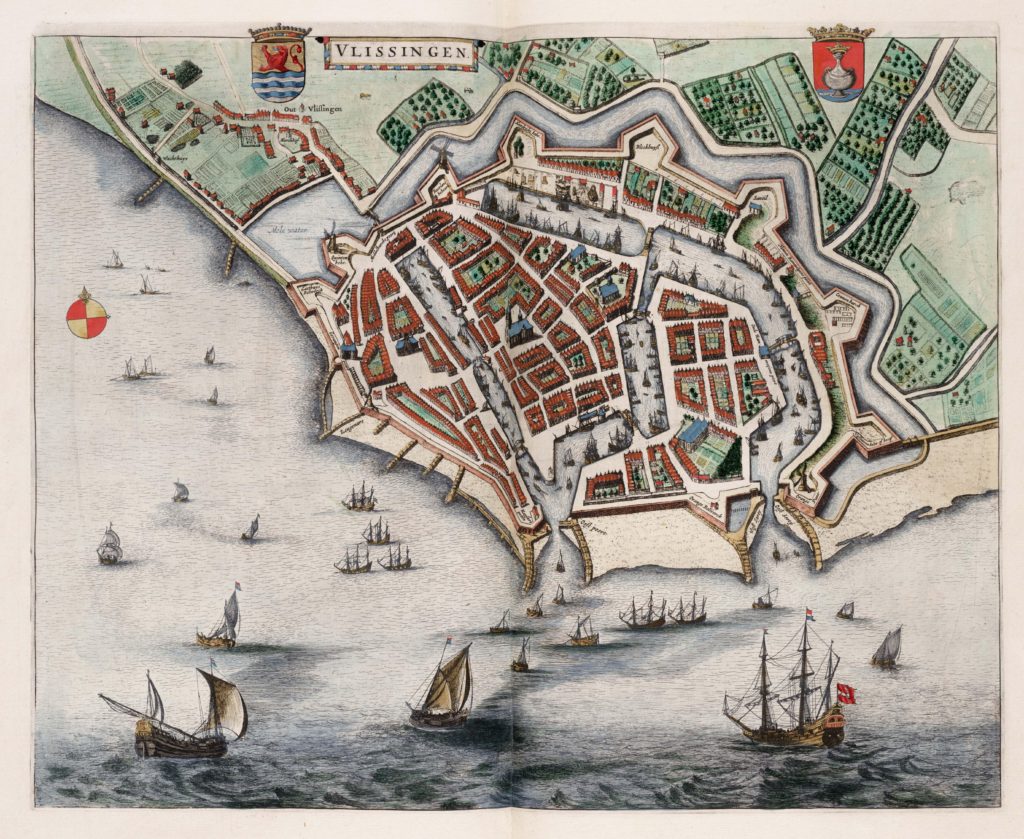
Vlissingen
Vlissingen

The town (Vlissingen or Flushing) was overcrowded and insanitary, the local hostile. The traffic of war passed through, incessantly, chaotically – soldiers on their way to the front, the cashiered and wounded on the way back home, and the usual wartime flotsam of profiteers, adventurers and spies, travelling in both directions and in neither.

The Reckoning

Charles Nicholl


He knew before he even opened his eyes that he was ashore. But not too far from the ocean, he could smell it, hear the gulls. It had stormed recently, he could smell that also. Ashore. But where? And when? How long have I been unconscious?  By the feeling in his flesh, he knew that he had been asleep for sometime. But, drawing in a breath, he felt no pain in his lungs from the ague and the pain of his stomach wound was much lessened. Christ, that long?

Nick opened his eyes. He was in a room in an inn; he recognized the type easily enough, small but not filthy. Light came in through the oiled paper in the one window, judging by its strength, sometime in the afternoon of a sunny day.

The room also contained a man standing by the door.  An average looking man, not too tall, not too short, not too handsome, not too ugly. Black hair under a cap, dressed in a travel stained doublet, jerkin, hose. A pleasant smile on his face. No reason for it, but Nick felt a sense of unease. Continue reading “(Broken Instrument) CHAPTER 20: NICK: THE MAN IN THE ROOM”

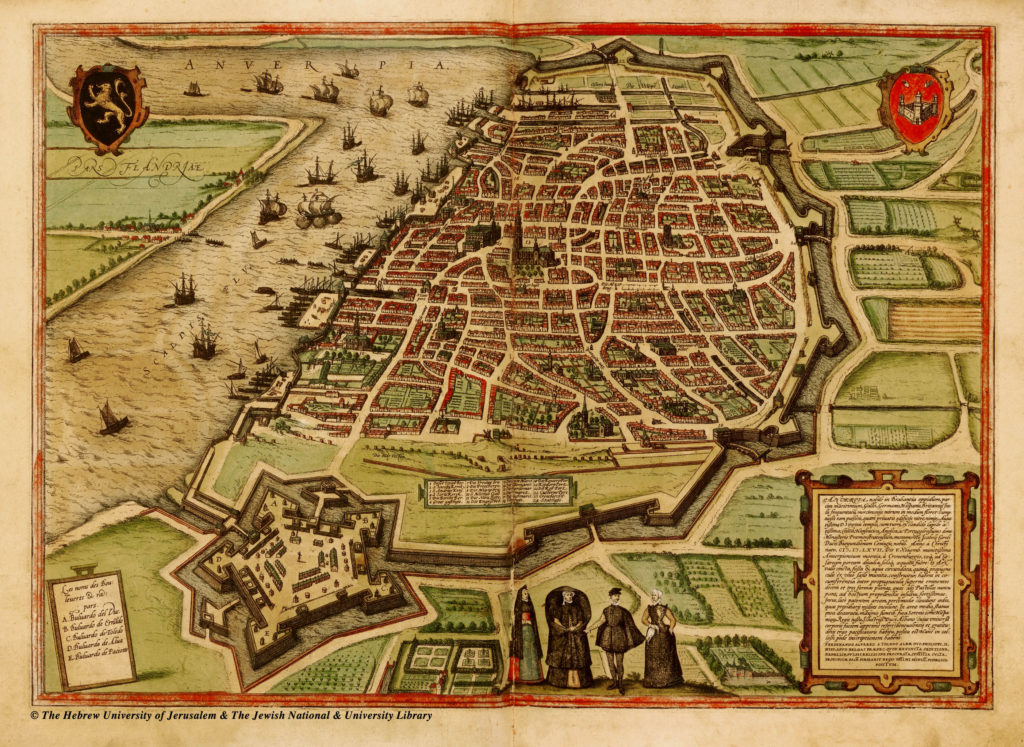
Antwerp
Antwerp

At that time Antwerp resembled post-Second World War Vienna, awash with spies, counter-spies, lies, and double dealing.

The Elizabethan Secret Service

Alan Haynes


“He’s gone.” Jean’s tone was phlegmatic.

“I know that we are to bow our heads and accept God’s trials as a proof of our worthiness in His eyes, but sometimes I do wish that He could see fit to ease our road. After all, we do His business!” Helmsley threw his hat and gloves on the table, ran his fingers through his hair. Then regained his senses and became aware of what outrages he had just uttered. In a fever of repentance, he pulled his St. Christopher medal out from under his doublet, kissed it, and silently begged God’s forgiveness for such a miserable sinner as himself.

Jean didn’t even look up from his bowl of mussel stew. Continue reading “(Broken Instrument) CHAPTER 19: HELMSLEY: TOO LATE”

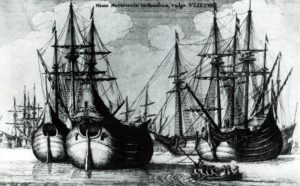
Fluyt

If on both sides trade with the enemy on payment of heavy duties was much better than no trade with the enemy, the prospect of trading at war prices without paying those duties was still more attractive, and the smuggler was everywhere at work. On both sides every variety of fraud was practiced to evade payment and to deal in prohibited wares.

The Scheldt Question To 1839

  1. S. T. Bindoff


The bells in the steeple above Nick tolled and he roused himself from the doorway where he’d spent a most uncomfortable night. Time to push off. The tide will turn and start ebbing in a few hours. If he’s in port, Great-Thirst will be grunting his way out of a whore’s bed and gathering his crew.

Next to the gate leading out to the Houc Quay wharf on the River Scheldt was The Beggar. Old, probably there when the walls first went up, probably there when people first started shipping cargo along the river. And it was probably a dirty disreputable drinking hole then. At the door, underneath the weathered carved bar’s namesake, Nick stood aside to let two drunken longshoremen stagger out, then entered the low, dim room. He moved quickly to the bar, not wanting to be lit in the doorway any longer than necessary. The barman stared at him expressionlessly through a fringe of long greasy hair.

The place was a fetid pit. The floor had never been swept, and there were piles of unidentifiable garbage in the corners, colonized by mice and roaches. Bad smells, sour beer, piss, spew. Light only entered the boozer warily, as if afraid of being beaten and left for dead. It was all very familiar to Nick.

“Beer.”

Without saying a word or changing expression, the barkeep pulled a mug worth of beer and slid it across the bar to Nick. He took a sip of the brew, found it sour but palatable, then turned to look at the people. There, at a table by the far wall, was the man he sought, a skinny man with his long legs stretched out underneath the table. Continue reading “(Broken Instrument)CHAPTER 18: NICK: GREAT-THIRST”

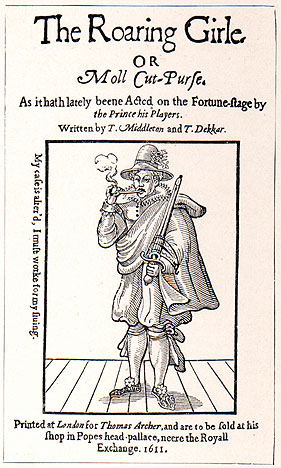
Moll Cutpurse. I based Meg on her.

From 10 August 1540 onward, the Privy Council clerks acted as the Council’s principal aides, working not for one but for all, and as subject to the precariousness of politics and events as the Councillors themselves.

Secretaries, Statesmen, and Spies

Jacqueline D. Vaughan


It was mid-morning and Robert Poley was in high and determined spirits. Yesterday had been a wild ride of success and mischance but he was intent on making this day be entirely under the benevolent eye of Dame Fortune. His humors were high and his blood fairly spun in his veins. He knew where he had to go and the laborious upstream rowing of a wherryman was much too slow for his mood. His rapid pace took him westward along Conning Street to Watling and past St Paul’s and out the city walls at Ludgate. The streets were still muddy from the night’s rain and he had to step quickly on occasion to avoid being splashed by passing wagons and coaches.

He took basic precautions, doubled back a few times, stopped here and there to see if any of those among the crowds of people in the streets stopped along with him, if any of the faces were familiar. By the time he passed through Ludgate, he was reasonably sure that he was not being followed. Continue reading “(Broken Instrument) CHAPTER 17: POLEY: THE CLEAVER”

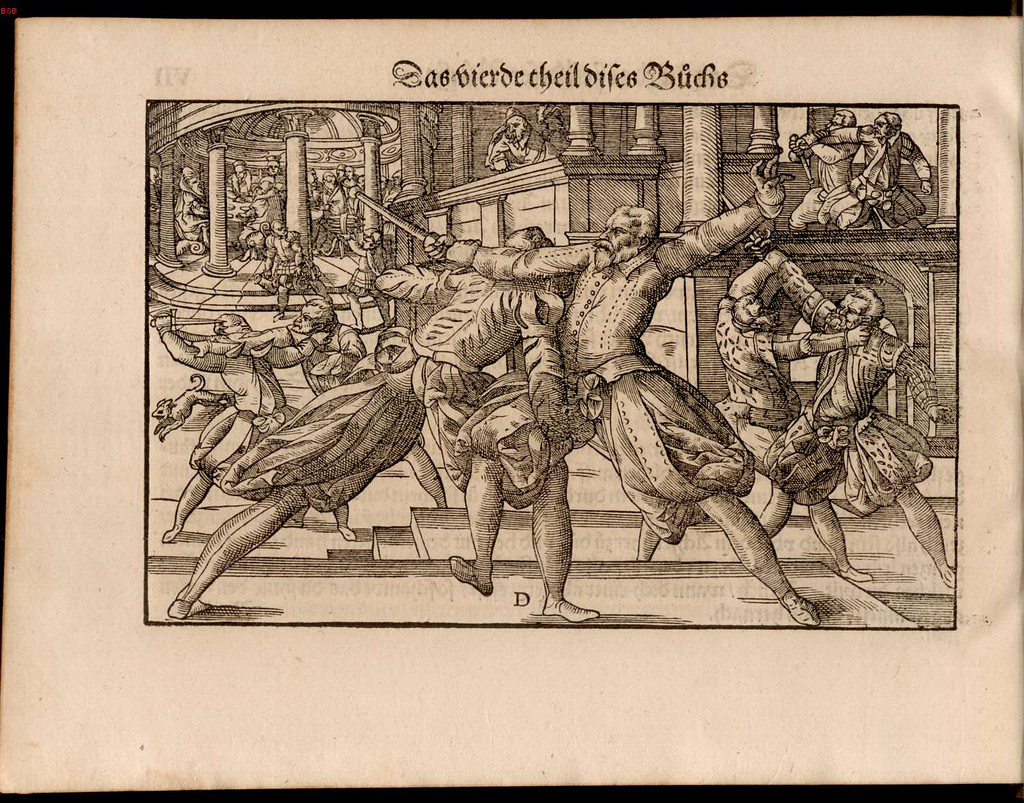
Joachim Meyer - Gründtliche Beschreibung des Fechtens 1570
Joachim Meyer – Gründtliche Beschreibung des Fechtens 1570

But the city was strongly garrisoned with crack Castilian troops and Protestants who refused to reconvert to Catholicism were ordered to sell their homes and immovable possessions and depart. Around half of Antwerp’s population, some 38,000 people emigrated to the north over the next four years (1585-89).

The Dutch Republic

Jonathan Israel


The next day, the sun was going down as they approached Antwerp, floating down the Scheldt. The canal had exited into the river a few hours earlier and their pace had picked up in the faster running river. The city’s glory days were long past. For as long as Nick had been in the Netherlands, Antwerp had been a shadow of its former self, when it had been the busiest port in Northern Europe. Now, after two sacks by the Spanish, the Dutch closing the mouth of the Scheldt, and the Protestants all fleeing  north, there were rotting wharves, decaying cranes, empty houses, few signs of people living outside the walls.

Fuck. Gets me every time. The ‘dam and Emden might be getting all the ships these days but I remember when Antwerp was the center of the fucking world. When I first came here, sailing for John Crookback, ships were so crowded along the wharves and quays that it looked like you could walk all the way across the Scheldt going from deck to deck.

The Inquisition will fuck up your business faster than getting drippy dick from a wharf-side whore. First they kicked out the Jews and now they’ve done the same to Protestants. And they all went north to Amsterdam, taking their money and business and brains with them. Continue reading “(Broken Instrument) CHAPTER 16: NICK: QUAY SIDE KNIVES”

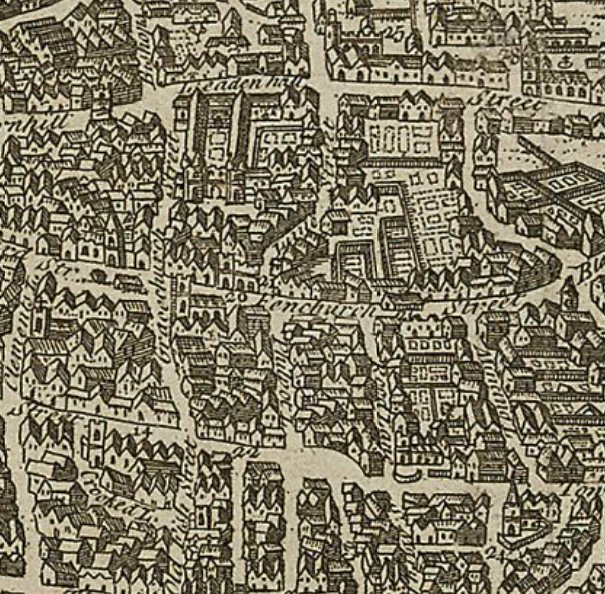
Lime Street
Lime Street

… but it was van Meteren’s skillful management of the post that made him indispensable. When the artist Marcus Gheeraerts wanted to send smoked herring to Antwerp, or Ortelius wanted gifts to arrive at his sister’s house in London, they inevitably went through Emmanuel van Meteren and his formidable network of middlemen, merchants, sailors, and travelers to ensure that precious messages and gifts reached their destination.

The Jewel House

Deborah Harkness


Unfortunately, the business at the Customs House had proven fruitless. There had been no sign of any Captain Barnes. There had been one other captain in from Vlissingen and he knew nothing of Moody.

Poley’s mood was dark and frustrated and to cap it off, the weather had decided to match its mood to his. The afternoon had passed in a succession of conversations, boat rides from ship to ship at anchor in the Pool, and a memorable visit to a male whorehouse looking for a Portuguese captain. And all the while the clouds had moved in from the west, wispy at first, then piling up and blotting out the light.

And now it was pissing down rain.

Lime Street during a sunny day was a pleasant prospect. It was a narrow twisting street from St. Dionysus Backchurch on Fenchurch to Cornhill and St. Andrew Undershaft and its tower that loomed over the surrounding houses. The houses were all very nice and there were no tenements. Continue reading “(Broken Instrument) CHAPTER 15: POLEY: A STREET OF STRANGERS”